
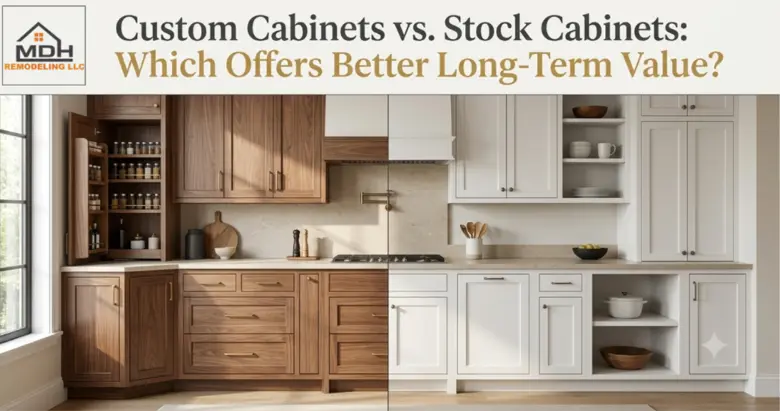
Key Takeaways:
- Custom cabinets offer greater design flexibility, while stock cabinets typically cost less and have shorter lead times.
- Cabinet longevity depends on materials, construction, installation, moisture exposure, and maintenance—not just price.
- Semi-custom cabinets can balance personalization, durability, and budget.
- Comparing the cost of custom cabinets vs. stock over their expected lifespan can help homeowners make a more informed decision.
- MDH Remodeling can help homeowners evaluate cabinetry options as part of a kitchen renovation.
When it comes to remodeling a kitchen, one of the most crucial choices to make is about cabinets. Cabinets have an impact on storage, look, usability, and budget for renovation. However, the cheapest initial cost isn’t necessarily the most cost-effective overall value.
Understanding custom cabinets vs. stock cabinets means looking beyond the initial quote. Construction quality, material choices, design requirements, and expected years of use all affect the investment.
Custom Cabinets vs. Stock Cabinets: What’s the Difference?
Stock cabinets are manufactured in standard sizes, finishes, and configurations. Because manufacturers produce them in volume, they are generally more affordable and readily available. However, fitting them into unusual layouts or accommodating specific storage needs can be challenging.
Custom cabinets are built to suit a particular space and homeowner’s requirements. They are available in flexible sizes, finishes, storage options, and materials. This can be particularly beneficial in kitchens that have unusual layouts, odd-shaped walls, or limited space.
When it comes to custom kitchen cabinets vs stock cabinets, it’s a matter of priorities. Simple kitchens can benefit from stock options, while custom designs provide more flexibility in the end product.
1. Compare Initial Cost and Long-Term Value
The cost of custom cabinets vs. stock varies considerably according to kitchen size, materials, hardware, finish, and labor. Stock cabinets generally have the lowest starting price, while custom cabinetry typically requires a larger investment because it involves tailored design and production.
But price is not the only determinant of value. If the cabinet is poorly made, it may require repair or replacement sooner, but if it is well made, it can last many years.
When looking at quotes for custom cabinets vs stock cabinets, be sure to compare the quotes that are the same in scope. Examine cabinet boxes, drawer make-up, hinges, finishes, installations, and warranties. Otherwise, it might get you a cheaper estimate that doesn’t cover the same features as the more expensive one.
2. How Long Do Kitchen Cabinets Last?
If you’re wondering how long kitchen cabinets last, there is no single answer. Lifespan depends on construction, everyday use, moisture exposure, maintenance, and the quality of installation.
Stock cabinets can provide years of service when made from suitable materials and properly maintained. Custom cabinets can also last for decades, particularly when their construction and finishes are designed for regular use. However, custom-made does not automatically mean more durable.
Cabinet boxes made from quality plywood, well-constructed solid-wood components, and durable hardware may offer advantages in particular applications. High-quality engineered wood can also perform well when appropriately manufactured and protected from moisture.
Inspect the actual specifications rather than assuming that price or cabinet category guarantees longevity.
3. Materials, Construction, and Painted Finishes
The durability has direct connection with the material. Usually, cabinet doors and frames are made of solid wood, and cabinet boxes are made of plywood or engineered panels. The properties of cost, stability and maintenance are different for each of the materials.
Construction matters just as much. Strong joints, properly supported shelves, quality drawer slides, and reliable hinges help cabinets withstand repeated use. Installation also plays a role, particularly where uneven walls or moisture-prone areas are involved.
Homeowners asking how long do painted kitchen cabinets last should consider the paint system, surface preparation, humidity, and cleaning habits. A durable finish can remain attractive for years, but paint may chip or wear around frequently handled doors and drawers. Repainting can refresh the appearance without replacing otherwise sound cabinets.
4. Custom vs. Semi-Custom Cabinets
For homeowners weighing custom vs. semi-custom cabinets, semi-custom cabinetry offers a middle ground. It typically starts with a manufacturer’s standard cabinet range but allows selected adjustments to dimensions, finishes, door styles, or storage features.
This can be more flexible than stock cabinets and with less of the expense of a completely bespoke design. Semi-custom options can be especially helpful when there are only a few changes that need to be made in a kitchen, but not enough to justify a completely custom design.
Compare available adjustments carefully. Customization varies by manufacturer, and not every semi-custom line offers the same construction quality or design choices.
5. Calculate Cost Per Year of Use
One practical way to compare stock vs custom cabinets is to divide the total installed cost by the number of years you reasonably expect the cabinets to serve.
Suppose, for instance, that the cost of stock cabinetry is $8,000 and it has a useful life of 15 years. It only costs around $533 annually. The equivalent of $533 per year would be $16,000 for custom cabinetry that lasts 30 years.
This calculation can help answer whether custom cabinets are worth it for your household. If tailored storage solves a persistent problem and the cabinets are built to last, the additional investment may be justified. If standard sizes meet your needs, stock cabinetry may provide better value.
Homeowners can use MDH Remodeling to determine what cabinets to consider when planning their kitchen remodel, from layout, functionality, and budget.
FAQs:
Q. Are custom cabinets worth the extra cost for long-term home value in the US?
Ans: They can be, particularly if they are customized to fit the storage needs, well-constructed, and integrated into a functional kitchen layout. But it isn’t only custom cabinetry that will increase the resale value of a home; some other local market factors and the overall value of the home renovation are also important.
Q. How many years do stock cabinets typically last compared to custom cabinets?
Ans: Both cabinets can last for years, and quality products can even be usable for decades. The level of assembled products’ construction, installation, exposure to dampness, and ongoing care are much better indicators than the classification of cabinets as stock or custom.
Q. What materials make custom cabinets more durable?
Ans: Depending on the design, quality plywood cabinet boxes, solid-wood components, durable engineered panels, strong joinery, and reliable hardware can improve performance. Custom cabinets are not automatically more durable; specifications matter.
Q. How does the cost-per-year calculation compare stock and custom cabinetry?
Ans: Divide the total installed cost by the expected years of service. For example, $8,000 over 15 years and $16,000 over 30 years both equal roughly $533 annually, before maintenance and other costs.
Q. Are semi-custom cabinets a better compromise for durability and budget?
Ans: They can be. Semi-custom cabinets allow minor variations in design to be made for a price that is generally more than the cost of stock cabinets, but less than that of custom cabinets. Prior to making any decisions, examine the materials, construction methods, options available for modifications, and warranties offered.